Thursday, July 29, 2010

Death by Elevator

Back before "Health and Safety" standards were a twinkle in the eye of law-makers anywhere, there existed a type of elevator that could thrill and chill at the same time. They are a dying breed (due to the fact they are ILLEGAL under EU law) but they can be found floating around a few old Prague buildings.

These are elevators that have no door and move in a continuous conveyor belt style. It doesn't stop on each floor, it just slowly goes continuously until it gets to the top and then slides over and begins the decent downwards in the same way. The brave traveler must carefully wait until the elevator is just at foot level and then jump in. The floors pass by in front of your eyes, and finger tips if you are brave enough to put a hand out. Then when the correct floor arrives, you jump out again. Calculate incorrectly and you
will find yourself sprawled on the marble floor.

Those elevator riders of the 1930s were living on the wild side.

Tuesday, July 27, 2010

Orlicke Hory: The final installment


Sunday: Home and Away

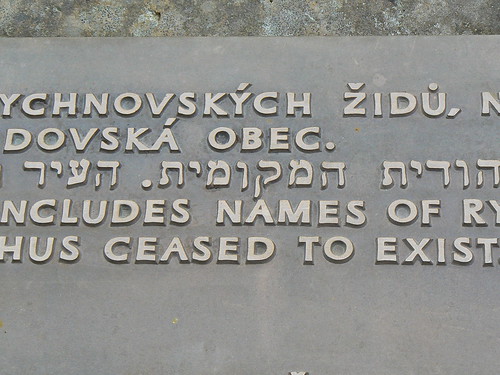
Sunday morning, our tummies full of ham and eggs, we set off for home. But on the way we made a few stops to see what local culture could offer us. Because of Karel Polacek, we were inspired to dig a bit deep into the Jewish history of the area. We started in Rychnov at the Karel Polacek Memorial. This building had once been the synagogue of a small but thriving Jewish community. About forty men, women and children were removed from their homes and sent to concentration camps with millions of others during the Nazi occupation and the Jewish community that had lived in Rychnov for around 400 years "ceased to exist" as the memorial states.

How does a culture and a community cease to exit? It's hard to imagine a place like this, when I grew up so close to my hometown's Jewish community. Of course, I'd studied WW2 and I was as mortified and horrified as any rational human is by the facts. But growing up I was surrounded by a very local vibrant Jewish community with a synagogue across the street from my high school. To be in a place where that community "ceased to exist" makes racism and nationalism and fear and ethnocentrism things not of the past, but demons we need to conquer today as well because they are very very real and relevant.

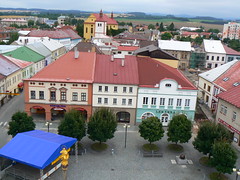
A short drive and we found ourselves in Dobruška (www.mestodobruska.cz), birthplace to František Kupka and F. L. Věk. (Don't worry, if you aren't Czech then I doubt you've heard of them. I never had until my history lesson from H!) Like dozens of small Czech towns, it was centered around a cute little square with cookie-cutter buildings and a clock tower that we climbed our way up to get the bird's eye view.

The last stop on the Orlicke Hory tour was Třebechovice. Blink and you'll miss Třebechovice. The claim to fame is the Nativity Museum where the prize possession is a 7 meter long, hand-crafted wooden Nativity from the beginning of last century. It is a sight to behold. Every crevis and corner revealed another scene. WOW sums up anything I could write about it.

And then we drove home and went to bed early, exhausted from all the mountain air, walking, good beer and Czech-ness of Orlicke Hory.

Orlicke Hory continued


Saturday: Finding Bunkers

Saturday morning the clouds were thick and full of rain. That was ok because we planned on spending a lot of the day underground in a bunker. After a delicious breakfast of scrambled eggs and all the trimmings, we were off.


Prior to WW2, the Czechoslovaks could feel the world around them changing. As a preemptive measure against invasion they made several alliances with France and Russia and then began fortifying their borders. They built scores of bunkers in the hopes of staving off invades long enough to give their allies time to swoop in and save them. Unfortunately, Czechoslovakia was carved up in the Munich Treaty, betrayed by her allies and invaded regardless of her efforts at defending herself.
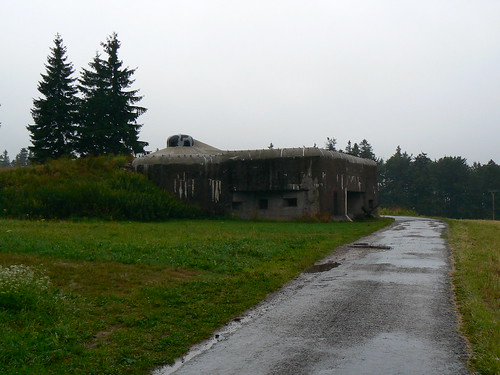
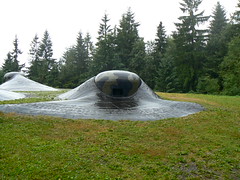
Now, when H said bunker I was thinking "tank size" with a soldier or two manning some guns. There are bunkers in the system like this, but Haniča was on a scale I couldn't imagine. It was designed for 420 soldiers (!!!) and had the feeling of being in the bowels of a ship. (www.hanicka.cz) The parking lot is about 2k from the entrance so there is a nice walk through the forest before going the 38 meters below ground. The tour takes about an hour and is very cool, as well as cold as the interior stays around 8 degrees Celsius.

Our second stop of the afternoon was less heavy, definitely lighter. It was in the village of Vamberk to see a lace exhibition (http://www.moh.cz/2010_img/vamberk201006.pdf). Vamberk and the Orlicke Hory region is known for their long history of handmade lace. It just goes to show how those Czech golden hands really can do anything!

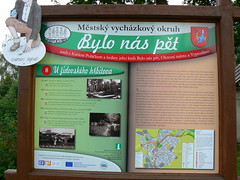
After dinner in Rychnov's local pizzeria, which surprised us with its sophisticated menu including veal, saffron rice and wild mushroom dishes, we decided to follow the trail of Karel Polacek's book "Bylo nas pet" (There were Five/translated: We were a Handful). The book is a memoir of his childhood. As you follow the map from sign to sign you learn about the places and people of a small town in the 1930s through the eyes of this little Jewish boy. The signs show photos of how the town looked at that time and give the historical significance of each site.